
O Mary, conceived without sin, pray for us who have recourse to thee.
— Words on the Miraculous Medal revealed to Catherine Laboure
Acts 11:1-18
1 Now the apostles and the brethren who were in Judea heard that the Gentiles also had received the word of God. 2 So when Peter went up to Jerusalem, the circumcision party criticized him, 3 saying, “Why did you go to uncircumcised men and eat with them?” 4 But Peter began and explained to them in order: 5 “I was in the city of Joppa praying; and in a trance I saw a vision, something descending, like a great sheet, let down from heaven by four corners; and it came down to me. 6 Looking at it closely I observed animals and beasts of prey and reptiles and birds of the air. 7 And I heard a voice saying to me, `Rise, Peter; kill and eat.’ 8 But I said, `No, Lord; for nothing common or unclean has ever entered my mouth.’ 9 But the voice answered a second time from heaven, `What God has cleansed you must not call common’ 10 This happened three times, and all was drawn up again into heaven. 11 At that very moment three men arrived at the house in which we were, sent to me from Caesare’a. 12 And the Spirit told me to go with them, making no distinction. These six brethren also accompanied me, and we entered the man’s house. 13 And he told us how he had seen the angel standing in his house and saying, `Send to Joppa and bring Simon called Peter; 14 he will declare to you a message by which you will be saved, you and all your household.’ 15 As I began to speak, the Holy Spirit fell on them just as on us at the beginning. 16 And I remembered the word of the Lord, how he said, `John baptized with water, but you shall be baptized with the Holy Spirit.’ 17 If then God gave the same gift to them as he gave to us when we believed in the Lord Jesus Christ, who was I that I could withstand God?” 18 When they heard this they were silenced. And they glorified God, saying, “Then to the Gentiles also God has granted repentance unto life.”
Bible Study: [1-18] The Jewish Christians of Jerusalem were scandalized to learn of Peter’s sojourn in the house of the Gentile Cornelius. Nonetheless, they had to accept the divine directions given to both Peter and Cornelius. They concluded that the setting aside of the legal barriers between Jew and Gentile was an exceptional ordinance of God to indicate that the apostolic kerygma was also to be directed to the Gentiles. Only in Acts 15 at the “Council” in Jerusalem does the evangelization of the Gentiles become the official position of the church leadership in Jerusalem.
Pss 42:2-3; 43:3-4
2 My soul thirsts for God, for the living God. When shall I come and behold the face of God? 3 My tears have been my food day and night, while men say to me continually, “Where is your God?” 3 Oh send out thy light and thy truth; let them lead me, let them bring me to thy holy hill and to thy dwelling! 4 Then I will go to the altar of God, to God my exceeding joy; and I will praise thee with the lyre, O God, my God.
Bible Study: [Psalms 42-43] Psalm 42-43 form a single lament of three sections, each section ending in an identical refrain (Psalm 42:6, 11[12]; 43:5). The psalmist is in the extreme north of Israel, far from Jerusalem, and longs for the divine presence that Israel experienced in the temple liturgy. Despite sadness, the psalmist hopes once again to join the worshiping crowds.
[3] See the face of God: “face” designates a personal presence (Genesis 33:10; Exodus 10:28-29; 2 Sam 17:11). The expressions “see God/God’s face” occur elsewhere (Psalm 11:7; 17:15; 63:2; cf Exodus 24:10; 33:7-11; Job 33:26) for the presence of God in the temple.
[3] Your light and fidelity: a pair of divine attributes personified as guides for the pilgrimage. The psalmist seeks divine protection for the journey to Jerusalem.
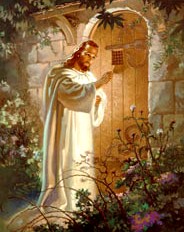
John 10:1-10
1 “Truly, truly, I say to you, he who does not enter the sheepfold by the door but climbs in by another way, that man is a thief and a robber; 2 but he who enters by the door is the shepherd of the sheep. 3 To him the gatekeeper opens; the sheep hear his voice, and he calls his own sheep by name and leads them out. 4 When he has brought out all his own, he goes before them, and the sheep follow him, for they know his voice. 5 A stranger they will not follow, but they will flee from him, for they do not know the voice of strangers.” 6 This figure Jesus used with them, but they did not understand what he was saying to them. 7 So Jesus again said to them, “Truly, truly, I say to you, I am the door of the sheep. 8 All who came before me are thieves and robbers; but the sheep did not heed them. 9 I am the door; if any one enters by me, he will be saved, and will go in and out and find pasture. 10 The thief comes only to steal and kill and destroy; I came that they may have life, and have it abundantly.
Bible Study: [1-21] The good shepherd discourse continues the theme of attack on the Pharisees that ends John 9. The figure is allegorical: the hired hands are the Pharisees who excommunicated the cured blind man. It serves as a commentary on John 9. For the shepherd motif, used of Yahweh in the Old Testament, cf Exodus 34; Genesis 48:15; 49:24; Micah 7:14; Psalm 23:1-4; 80:1. [1] Sheepfold: a low stone wall open to the sky. [4] Recognize his voice: the Pharisees do not recognize Jesus, but the people of God, symbolized by the blind man, do. [6] Figure of speech: John uses a different word for illustrative speech than the “parable” of the synoptics, but the idea is similar. [7-10] In John 10:7-8, the figure is of a gate for the shepherd to come to the sheep; in John 10:9-10, the figure is of a gate for the sheep to come in and go out. [8] [Before me]: these words are omitted in many good early manuscripts and versions.
/ raangulo

Get Skype it’s free.
Check out my blog at http://raagroup.blogspot.com/ where daily readings and more are posted daily.




 One Walk